

Today, an employee performance review is a norm in every organization. It’s a way to measure how well employees perform and their contributions to the company’s bottom line. Over time, more companies see performance evaluation beyond rewarding and punishing employees for the previous year, and organizations see it as a way to give feedback to improve performance.
One such method is the 360 degree feedback method. This article will explore the meaning of 360 degree feedback, its history, importance, and steps when conducting one.
What is 360 Degree Feedback System?
360 degree feedback is a system where employees receive feedback from multiple sources or from different persons who work closely with them. For this reason, it is also popularly referred to as a multi-rater or multi-source tool. The 360 degree feedback definition says multiple sources, so who are these sources? They are the supervisor, direct subordinates, or peers of the employee. Sometimes, the list of raters also includes customers and suppliers. The number of raters (those assessing the employee) varies from as little as six to as many as eleven. In some companies, the 360 degree also includes a self-assessment form with similar questions.

Source: factohr.com
History of the 360 Feedback System
360 degree feedback may seem like a relatively new management feedback system, but its origin date over 100 years ago. During the First World War, the American military used 360 degree evaluation on its soldiers. However, it didn’t have this fancy name and didn’t include peer review then.
This changed when the German troop used it again in World War Two, and they used it to determine the wages and promotion of their soldiers.
It would be in the 1950s that the multi-rater tool came into the business. The Esso Research and Engineering Group used it. And was widely successful, increasing productivity and profits – ExxonMobil acquired them because of the improved performance.
What truly brought 360 degree feedback to the limelight was the cutthroat use of it by the then General Electric CEO Jack Welsh as a performance measuring tool. He famously fired the bottom 10% of workers.
From that period, multinationals worldwide adopted it, becoming the go-to HR performance management tool of the time. Due to how time-consuming and labor-intensive it was, it slipped out of fashion for a period. But the introduction of the internet has seen a sudden rise again.
So much so that over 85% of the Fortune 500 companies use 360 degree feedback in one form or the other.
Understanding the 360 Degree Feedback
Although the roots of the 360 degree method are performance appraisal, this is changing in many organizations. 360 degree assessment is a tool to complement an existing performance tool and not replace it. Understanding this difference in purpose is essential because if employees view 360 degree feedback as a way to promote or punish them, an honest review is out the window.
This was a problem many companies faced in the late 80s up to the early 2000s. In a Harvard Business Review article, Maury Peiperl recalls one problem management encountered in his 10-year study was the “Role Peer Paradox.”
This paradox was when peers didn’t want to be the reason they fired another employee, got a pay deduction, or ruined their relationship. And this was still the case, even when anonymous. He also saw similar reactions in close-knit teams that work well together or have a decline in their performance.
360 degree feedback can be a powerful and helpful tool when properly implemented. One reason 360 degree feedback has mixed results is its use and purpose.
The aim is to use the feedback to work on employee weaknesses while improving their strengths. It is not a decisive tool to measure an employee’s performance, and it can help to identify why an employee has performed in a certain way but shouldn’t be used to measure performance.
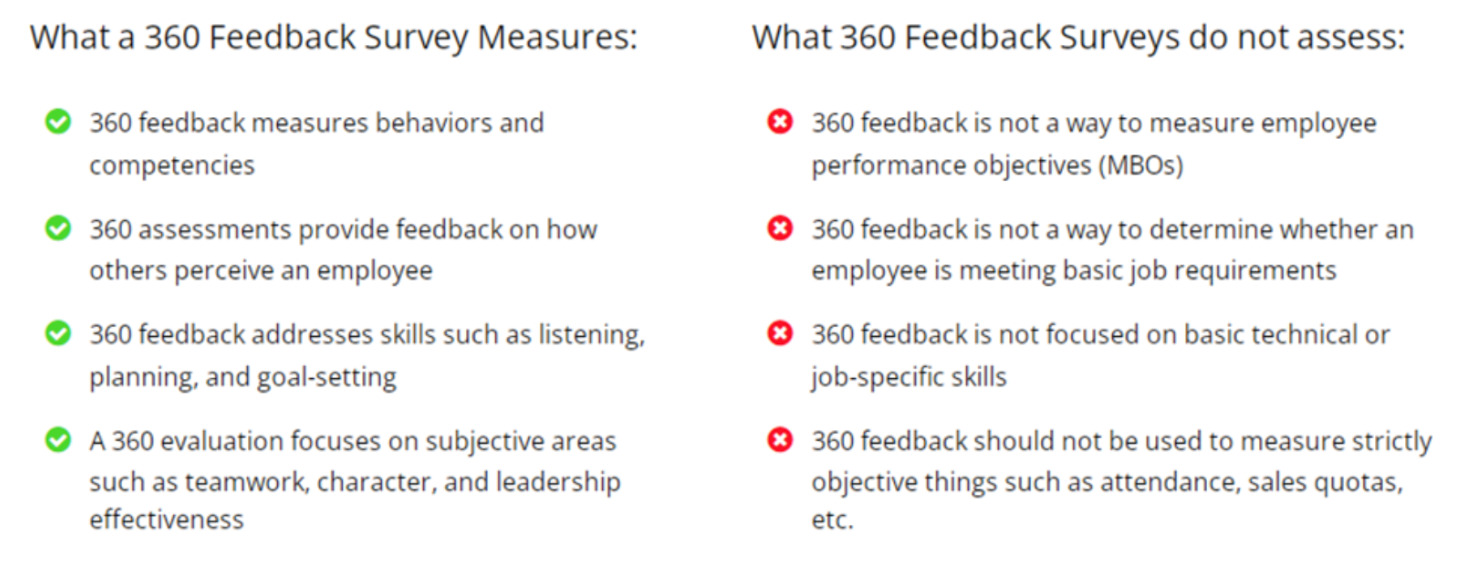
What 360 Degree Assessment Measures
- 360 degree evaluation measures qualitative attributes like behavior and competency, not necessarily measuring an objective or performance metric.
- It measures more subjective aspects of work, like teamwork, leadership, effectiveness, goal-setting, and character. And not on objective measures like Sales Quota per month.
- 360 degree looks at how others see you, but a performance assessment tool would look at the job skill and how well the employee uses those skills.
- 360 degree assessment can help explain employee performance and help figure out how to improve it, but it shouldn’t measure it.
Source: Custominsight
Benefits of 360 Degree Feedback
When applied correctly, 360 degree assessment can bring many benefits to both employees and employers. This section looks at some benefits of a well-implemented 360 Degree Feedback system.
Holistic Feedback from Multiple Sources
Receiving feedback from different people can help staff members look at themselves from multiple views. They can understand how others view them, how they influence others’ work and the quality of their work.
Helps Reduce Personal Bias and Discrimination
Getting ratings from separate individuals with different functions and relationships can help reduce discrimination or bias. The review also weakens the Halo or Recency effect, and a biased manager or a peer will not affect the rating.
It Helps Employees Draw Up a Development Plan
One of the main reasons for conducting a 360 degree assessment is to build a development plan based on the employee’s strengths and weaknesses. This development plan may involve training they have to take, improvement in communication skills, or other forms of help the employee needs to improve performance. Tracking their progress is essential to the long-term effect of their development plan.
It Exposes Inefficiency In Organization System
Every organization has some procedure or rule that can limit its employees. 360-degree feedback system can help organizations identify those bottleneck procedures and processes that cause delays or inefficiencies. It may need the removal of a process or scheduling training for employees.
It Improves Team Development
Team members getting to know their strengths and weaknesses can help develop individuals and the team. It can also lead to discussions, where team members open up to each other about how to improve themselves. Since this session is to develop and not measure performance, teammates should be open to suggestions. A direct manager should help manage the situation.
What to do Before Administering a 360 Degree Feedback Questionnaire
If one doesn’t know how to use a tool, they either under-utilize it or misuse it. The same concept applies to 360-degree feedback. Before administering it to the organization, here are some activities to do.
Explain to Employees The Purpose of the Assessment
Employees buying into the process is always a great way to start. Management buying into it is the first phase. Employee education on why to devote their time filling questionnaires should be a priority. Grant them the platform to ask questions and share their concern with management. Doing this ensures that employees fill these questionnaires accurately.
Properly Train Managers to be Effective Coach
Schedule classes for managers who will act as coaches for the feedback process. It’s vital that managers are adequately informed and equipped to handle discussing employee feedback. A Forbes article recommends introducing employees to the SARAH model.
The SARAH model shows us the various stages employees go through after receiving unfavorable feedback. They are Surprise, Anger/Annoyance, Rationalization, Acceptance, and Help. As a trained coach, you want to ensure people don’t rationalize why they receive such feedback but get them to the Help stage.
If the training is time-consuming, hiring a professional service to help conduct these will be better. Messing up the coaching aspect of 360-degree feedback can jeopardize the entire process.
Test the Assessment in One Section of the Organization
Before deploying it throughout the organization, test the process in a department to see its performance. This initial trial will teach management the most effective way to disburse the questions, the time to complete the survey, the employee attitude towards it, and ways to improve it. It helps HR and Management make evidence-based decisions.
Ensure it Complements the Existing Performance Review Tool
The 360-degree feedback should be able to support the existing performance management tool.
It Should be in Line with Organizational Goals and Objectives
Don’t conduct 360-degree feedback because others are doing it. Organizations need to tailor questions to their goals and objectives.
Steps to take when Conducting 360 Degree Feedback
Depending on the size of your company, conducting a 360 degree feedback survey can take several days to weeks. But ensuring you follow these steps should help.
-
Establish the Criteria for Employees
The administrator will need to tailor questions relating to the employee’s department.
The questions should come under the following headings:
- Communication
- Organization
- Teamwork
- Interpersonal Skills
- Creativity
360 feedback examples under Teamwork can include:
- Does this person give fair and constructive feedback to teammates?
- Does this person work well with their colleagues to meet company goals?
- Does this person help to lift the team spirit whenever the team is down?
-
Choose the Persons to Assess Each Employee
Those rating the employee should have a working relationship with them. The peers are co-workers in the same department or a department that works closely with theirs. The supervisor should also have regular interactions with the employee.
-
Send the Questionnaire Out to these Persons
Send the questionnaires to those chosen. Specifying a deadline of a week or two will help you get the feedback quicker. Send reminders during the two weeks.
-
Send the Same Survey to Employees for Self-Assessment
Employees should also get a copy of the questionnaire. It’s always good to know how they see themselves compared to how others assess them.
-
Set a Date and Time for the Evaluation
Pick a date and send this information to every staff through the company email.
-
Review the 360 Ratings with the Employee
This is the most crucial part of the process. The manager, HR personnel, or external professional must allow the employee to understand the assessment and the steps to take afterward.
-
Follow-up and Employee Progress
Following up is crucial as it keeps employees accountable and lets them understand the change isn’t short-term. Following up also allows you to see the long-term implication of the development plans.
Conclusion
In conclusion, 360 degree feedback isn’t about doing what others are doing. It’s a deliberate effort to improve the performance of the employees and, by extension, the organization. Conducting 360 degrees accurately can lead to a better-performing organization and, in the long run, a culture that supports continuous growth through constructive feedback.


