

Here was how a traditional route into a software career traditionally looked: Learn to code, get hired in as a junior developer, work your way up to senior over 3–5 years. That path is not dead. But for the first time ever, it is no longer the key entry into the space.
SignalHire signals more to recruiters than just the basics by leveraging real-time recruiter search behavior across its 850M+ professional database. The company registered global recruiter searches in the software development sector between January and April 2025 and the equivalent period in 2026.
The pattern is narrow and not what you might expect: recruiting demand for the breed of roles that generates code is dwindling. We now experience a boom in roles that test, translate and support what AI-generated code produces.
Goldman Sachs data shows that as overall employment continues to rise, the number of software developers aged 22 to 25 fell by nearly one-fifth since its peak in late 2022, while employment for more experienced workers remained stable.

The thesis is this: Artificial intelligence did not kill entry-level tech work. It has relocated it. New entry points all exist because AI-generated code needs to be verified, clarified, and brought to life by someone who understands both what has been technically produced and in what business context it will be put into motion: quality assurance, business analysis and IT support.
Key Takeaways
- Recruiter searches declined year on year for Junior Software Engineer and Software Development Intern roles.
- The huge spike in QA and Testing Junior also reflects the need for more human observation over AI generated code.
- Business Analyst Junior jobs also went up for the same reason; they are where one translates AI based technical output to business actions.
- The surge in IT and Tech Support Associates was driven by new support gaps due to AI tool adoption.
- Specialized developers stayed the same and suggests depth still means something to recruiters.
- There is a drop in the Data Science and ML Intern positions, these could be indicative of how saturated this first wave front line AI hiring has become.
- Data Analytics Interns, so small rises in the numbers of interns suggests yet again, we are still at a time when analytical support to AI workflows remains very much human-based.
- The hackneyed learn to code, get a junior job pipeline is being replaced by `learn to test, translate and support AI outputs.
What Does the Software Development Recruiter Data Actually Show?
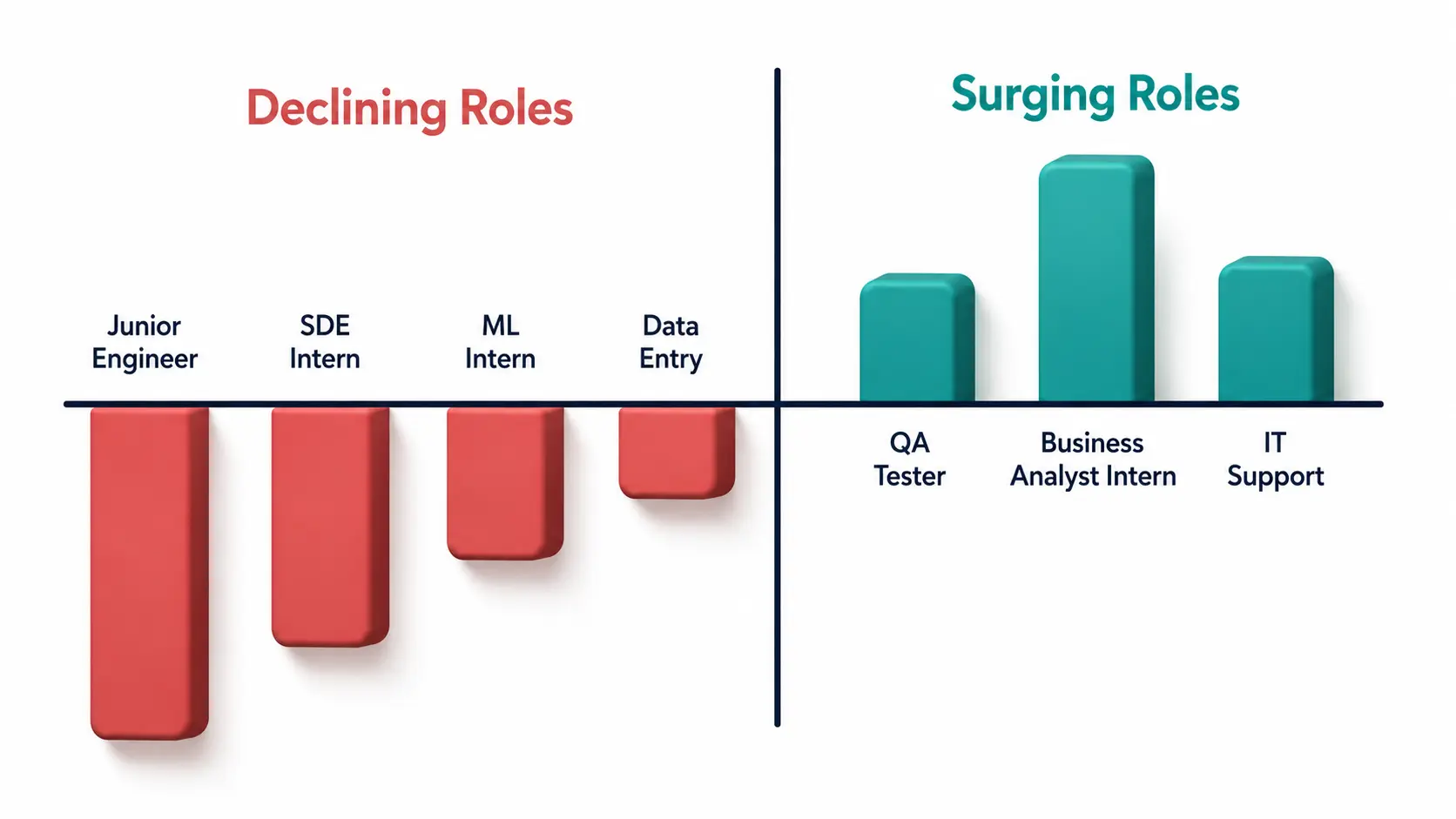
Narratives about AI and software jobs are often black and white. It either means artificial intelligence will figure out how to automate developers out of existence, or we need every engineer we can get because software will ultimately supplant every industry. Neither of those future scenarios have come to fruition, according to data provided to SignalHire. Which indicates that there is a reset happening in present directly at entry level.
| Role Category | Trend | Signal |
| Junior Software / Full-Stack Engineer | Declining sharply | Core coding function compressing under AI tools |
| Software Development Intern | Declining sharply | Traditional code-writing internship losing recruiter interest |
| Data Science / ML Intern | Declining | Initial AI hiring surge stabilizing |
| IT Data Entry Clerk | Declining | Structured data handling increasingly automated |
| QA & Testing Junior / Intern | Surging dramatically | AI-generated code needs human verification at scale |
| Business Analyst Junior / Intern | Surging dramatically | AI outputs need human translation into business decisions |
| IT / Tech Support Associate | Surging sharply | AI tool adoption creating new support layer |
| General IT Intern | Growing | Broad technical support demand expanding |
| Junior Specialized Dev (.NET, Java, App) | Stable/modest growth | Specificity retains value where generalist coding does not |
| Data Analytics Intern | Modest growth | Analytical interpretation of AI outputs remains human |
Why Are Junior Software Engineers Declining in Recruiter Demand?

Given that so much of that grunt work, of course, the process that describes your very first few years of a junior dev’s career is, at this stage, practically reasoning 1 automatized.
AI code generation tools handle boilerplate code, fix up syntax errors, scaffold unit tests and integrate with multiple APIs, including GitHub Copilot, Cursor, etc.
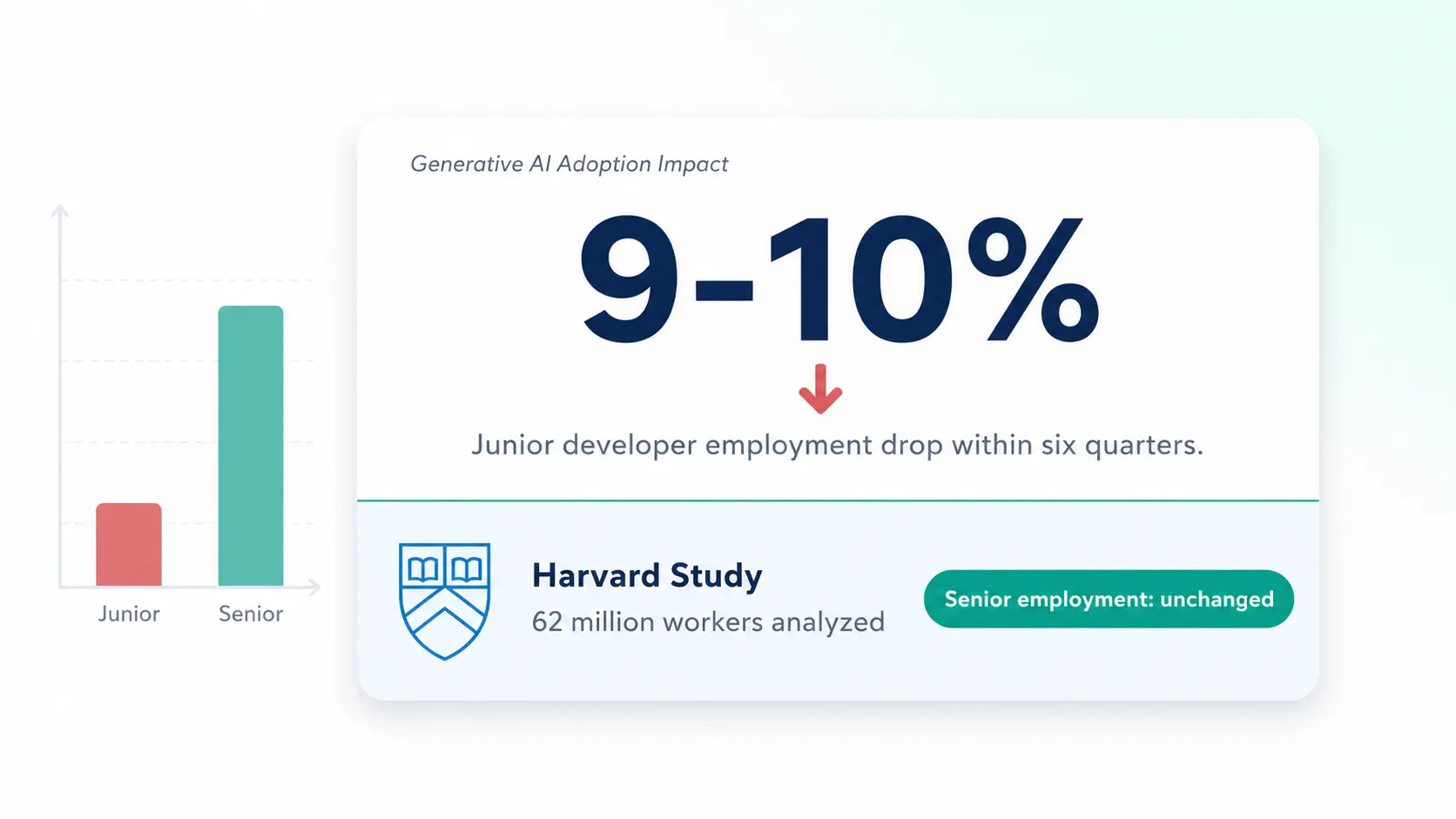
A Harvard analysis of 62 million workers finds junior developer employment falls by around 9 to 10% in the six quarters after a firm adopts generative AI, while senior employment barely moves at all.
The internship decline compounds this. The idea of a software development internship pipeline where companies would have juniors come build software, only to hire them full-time after they graduate and become seniors, is becoming antiquated. Compress the junior function and then the pipeline rationale goes out of the window.
An example of the initial trend in our data, shown in socket six is that quarterly recruiter searches for software development interns appear to have plummeted year-on-year on the precise timing with the end of a major surge from ten-times as high as trend levels, and organizations restructured engineering teams into a pattern resembling AI-assisted brain power augmentation for senior people over junior ones.
Gartner predicts that by 2030, every IT work will be AI-related, with 75% of roles becoming characterised as AI-augmented and 25% performed autonomously with human involvement. They’re filling positions in anticipation of what their operating model will look like in 2028 and 2029.
Why Did QA and Business Analysis Interns Surge So Dramatically?

Because someone who cannot test or explain automatically must do that with AI-generated code.
After the trend for QA and Testing Juniors, it is the best signal in the full dataset. Since AI tools can now create code faster than any human developer could write by hand, the limiting factor changes from speed of production to quality of output. An AI coding assistant has no clue what code it generates will break in production, create a security vulnerability, or conflict with existing system dependencies. A QA engineer who runs test scenarios, edge case analysis, and integration checks knows, or is trained to get the facts.
The surge for the analysts at junior levels maps on the same logic, but is at different layers. Technical results from AI models – such as code, data models or recommendations for system architecture, need to be translated into human language that product teams, executives and non-technical stakeholders can understand and act upon. A junior business analyst who grasps the technical context of this knowledge but is able to articulate what that means in a business sense will be doing something the AI cannot do on its own.
McKinsey estimates that 57% of US working hours are automatable using technologies available today; however, automating technical production does not mean we avoid denigrating the human judgment associated with verifying, contextualizing and deploying what that much automation produces.

QA and Business Analysis, the two top roles in terms of growth found in the dataset. are exactly the domains that lie at the intersection between what AI produces and what can be trusted and applied by people. The new entry point is that interface.
IT Support’s Sharp Rise: The Hidden Story in the Data

IT and Tech Support Associates surged in searches by recruiters YoY. This appears, at first glance, a strange companion to the story of AI shrinking the tech workforce.
This explanation does not contradict and rather it is operational. When organizations deploy AI tools at scale, these tools need constant human support: Configuring them, fixing issues with integrations, training users, answering help desk tickets and alerts when something in the system has failed. With each deployment of AI at enterprise scale you create a support burden that did not exist prior.
This is NOT IT as usual, password resets and printer failures. A new support layer for AI-augmented workflows: enough technical literacy to grouch failures of the AI but without the deep engineering know-how needed to drive systems. This is the turf of IT and Tech Support Associates, and the recruiter search data shows companies are in fact actively creating this role now that AI tools are more being adopted by teams internally.

The SignalHire browser extension is built for exactly this kind of sourcing, where the role definition is new enough that candidates with precisely the right profile are not concentrated in obvious places. Live contact lookup at the point of LinkedIn profile review lets recruiters evaluate and reach IT support specialists with AI tool experience without running a separate platform search.
The Roles That Did Not Move, and Why That Matters
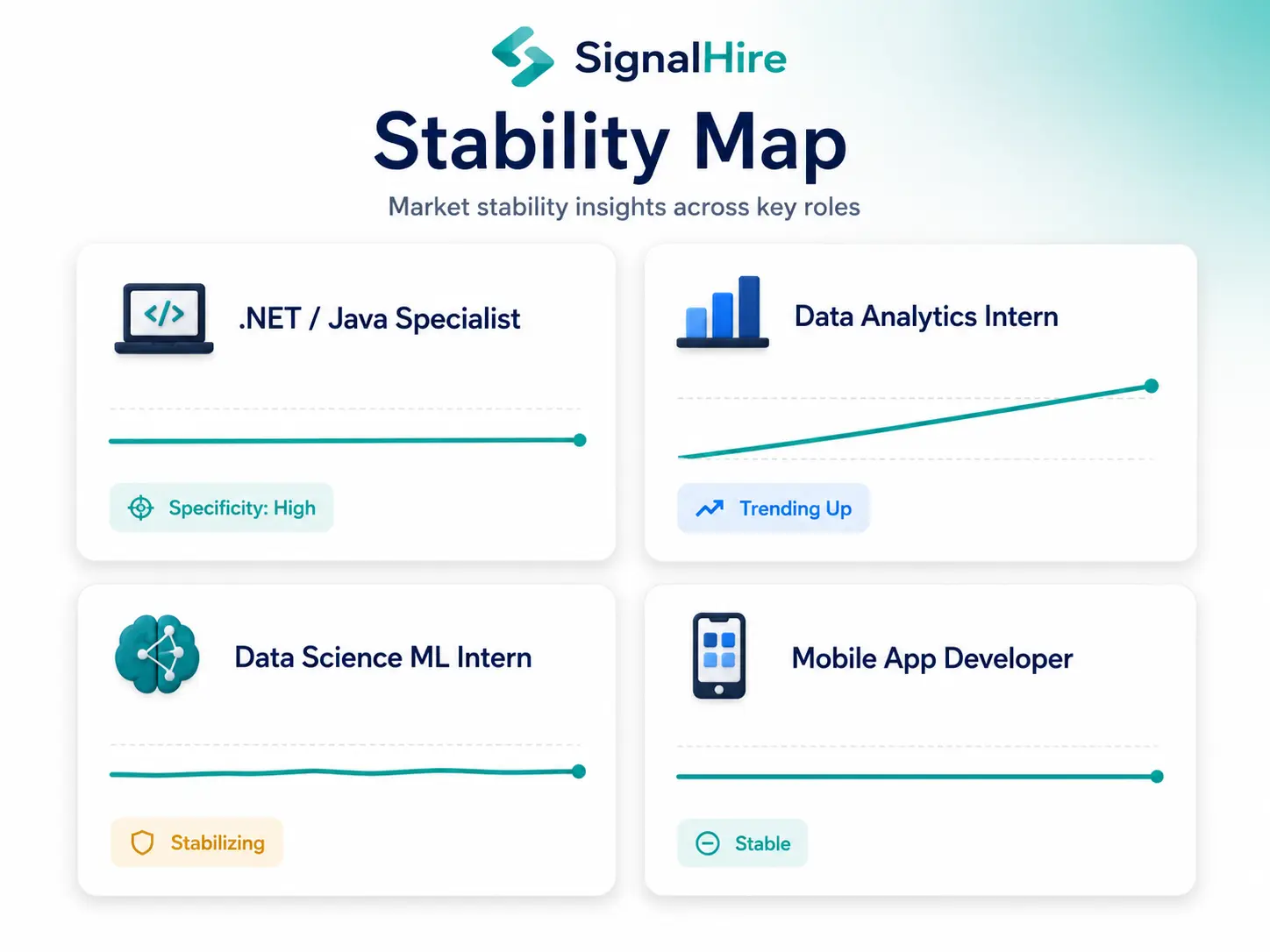
Junior Specialized Developers in. There was a slightly positive trend in the NDA, but .NET, Java and mobile application development remained flat in recruiter interest. Data Analytics Interns grew modestly.
That special developer stability has a lesson in and of itself. Generalist junior coding is declining. That’s not specialist junior coding in preserved enterprise stacks. Organizations running. Because AI coding tools are so much less reliable than human developers working in complex legacy codebases, NET infrastructure and Java backend systems and native mobile applications still need to be deep natives of those environments. The narrowness of the skill affords protection that broad coding capacity does not.
The stability of a Data Analytics Intern tells me that interpreting data outputs is still a human function organizations do not want (or can afford) to fully automate yet. Even more complex is the analytical judgment layer where determining which metrics matter, what a trend really means in terms of business action, how to communicate uncertainty to a decision maker etc., all continue to keep recruiters’ attention for such roles
The Data Science and ML Intern roles fell, which may indicate a pause in initial hiring surge into AI rather than a collapse of interest. We see that organizations which had moved aggressively to build data science capacity in 2023 and 2024 have addressed their immediate needs. The demand is unchanged but the acute pressure to fill roles has diminished.
What This Means for Tech Recruiters Right Now

By 2026, the market for software development talent will be divided into three individual pools that are moving at different rhythms.
Contracting of the first pool, junior generalist developers. Recruiter searches are down. The candidate supply has not adjusted yet, since CS graduates still enter the market with expectations of leading to a junior developer path. Which means that misalignment has talent but not the right profile role.
And the second pool, entry-level QA testers and business analysts is growing quickly. Because neither role is traditionally viewed as an initial entry point into tech, the candidate pipeline is smaller than the current demand for these roles. Recruiters competing for QA and BA juniors with experience in AI tooling are drawing from a pool that has not yet grown to meet recruiter interest.
The third group consists of specialist developers in the field of. NET, Java, and mobile are stable and competitive. Sourcing in this pool is about quality over quantity.

The SignalHire software development company database and the integrations that push verified contact data directly into ATS and CRM platforms are built for this kind of differentiated sourcing.

For teams working with the API, SignalHire’s API documentation covers automated bulk enrichment workflows for high-volume sourcing across all three pools.
SignalHire Jobs Reports 2026: The Full Series

This article is the third in our series here at SignalHire analyzing AI’s impact. The methodology behind each report is identical: year-over-year, same category role to real-time recruiter search data comparison.
- The Finance Job Market in 2026: Corporate Finance & Restructuring Associates spiked while generalist finance interns dropped off a cliff. The trend is consistent with research from the software data that shows a two-way dynamic: AI is driving down headcount by bundling repetitive aspects of financial processing and generating demand for jobs that oversee, interpret, and govern AI-transferred outputs relating to finance. The sharpest decline was among Investment and Equity Junior Associates (-91%) due to AI-enabled automation of research synthesis and model generation at the entry level.
- The Legal Job Market in 2026: Labor and Employment Associates increased by more than 700% in recruiter searches, making it the new fastest-growing practice area overall, caused solely by the introduction of AI employment tool regulations that opened up new avenues for discrimination lawsuits and compliance obligations. Litigation Associates plummeted as AI replaced document review and discovery. We see from finance and software that there is a similar redistribution pattern here: AI creates demand for the roles which manage its consequences, also seen in legal.
- SignalHire Global Jobs Report 2026: Out of the five markets in the cross-country analysis, Physical Therapist and Physical Therapist Assistant had the largest surges in virtually every part of the world, while Digital Marketing Specialist and Software Engineer were down across geographies. This sector-agnostic trend unfolds: roles that need FTF, regulated judgement, or AI output supervision are on the employer radar. Jobs where AI is now doing core deliverables are losing it.
Conclusion
The thesis held. The advent of AI does not erase entry-level tech jobs. It has relocated it.
The junior software engineer route, which has been the key entry point into the industry for around 20 years, is contracting under the pressure of AI tools that can perform its core function faster and cheaper. Instead, new entry points are appearing. Quality assurance, Business analysis, IT support. Both exist specifically because AI (enabled) outputs need to be tested, translated and maintained in operations by humans as the tools that generate those outputs cannot operate independently of humans.
The players a few moves ahead of the game will develop their pipelines for QA and BA entry level talent before the market has priced in said demand. Those waiting for junior software applications to enter their pipelines as they did in 2021 will have to wait much longer than expected, and increasingly the applicants they are waiting for are coming onto the market with a misalignment of expectations about which roles are really open.
The data is clear. The entry point has moved. The thing is that the recruiters searches on already know this.
FAQs
1. Is the junior software engineer role disappearing in 2026?
The repetitive drudgery that once characterized early career developer work has now been absorbed by AI coding tools, leaving recruiters looking desperately for newly minted generalists.
2. Which entry-level tech roles are actually growing in 2026?
According to the SignalHire data from 2026 recruiter search of entry-level tech roles, QA and Testing Juniors, Business Analyst Interns, as well as IT and Tech Support Associates, are notable in the past few years for being among the fastest-growing entry-level tech roles. These roles exist in the overlap between AI outputs, plus verification, explanation, and human support.
3. Why are QA and testing roles surging when AI is supposed to automate testing?
AI tools produce code faster than any developer, thus increasing the amount of production which must be human-verified before it is heading towards production. QA professionals serve as that oversight layer AI generated code can not provide on its own.
4. Are specialized developers like .NET and Java engineers also declining?
The Recruiter interest for the specialized developers in maintaining enterprise stacks had a near flat with a slight positive trend. Complex legacy codebases are less well-suited for AI coding tools, meaning that deep technical generality in established environments nevertheless retains recruiter value.
5. Why did Data Science and ML Intern searches decline despite AI growth?
The most urgent needs have largely been met for organizations that aggressively built data science capacity in 2023 and 2024, and the acute hiring urgency has given way to a more stable replacement drumbeat.
6. What should tech recruiters prioritize sourcing in 2026?
The most pressing sourcing gap comes from QA testers and business analysts who can work with these AI tools, the fastest-growing demand pool, which hasn’t yet caught up to an already imbalanced pipeline of talent. Specialized developers in. NET, Java and even mobile continue to be provisioned on a competitive, accurate sourcing vs. volume basis.


